Posts

Leonora in the Morning Light by Michaela Carter

Image
  Leonora Carrington (1917-2011) was a British-born Mexican artist, surrealist painter, and novelist. London, 1937. Leonora studies art in London, not something her father approves. She is introduced to “these Surrealists – not studying, but living their art.” One of them is Max Ernst, married and twice her age. She is captivated by his persona. When Max’s work is being seen as an immoral mind and having “bad influence on the good people of London,” he needs to leave London. When “Hitler declares Modern Art degenerate,” Peggy Guggenheim makes a bold move to support the Modern Art and the artists fleeing to safety. In Paris, despite the women not being able to fully join the movement of Surrealism, Leonora attends their meetings; followed by display of her paintings. She should be happy, but she feels some emptiness. A heart stolen by a man. Southern France, 1940. Max once welcomed in France, now not so much. “Writers, artists, Jews.” All wanted by the Nazis. “They were enemies in a...

The Social Graces by Renee Rosen

Image
 This story brings the Gilded Age of New York and Newport, and the rivalry of two socialites: Caroline Astor, a Knickerbocker, so called Old Money and Alva Vanderbilt, the nouveau riche, so called New Money. Told with humor, we get to see the opulence and experience the Gilded Age. New York, 1876. Alva Vanderbilt, coming from impoverished family and marrying a rich man, thought it would automatically give her an entrance to society. But she was mistaken. Why is it so important to be part of society? It is the realm of women, the only place where they don’t have to answer to men. Caroline Astor feels that society must be preserved, women with tiaras and men with cigars. She is a champion of Old Money and tradition. The assault by the nouveau riche is reeking “of newly minted steel and railroad money.” New Money meaning made money is seen as tasteless. One’s wealth should be inherited, not earned. You inherit money “in addition to marrying yet more money.” Despite Old Money guarding ...

The Elephant of Belfast by S. Kirk Walsh

Image
  Inspired by true story of Denise Weston Austin. So called the “elephant angel.” Belfast, N Ireland, 1940. An orphaned elephant leaves an island of Ceylon to make a new home at Bellevue Zoo. At the docks, Hettie Quin, zookeeper, meets a three-year-old elephant named Violet. Violet becomes Hattie’s favorite charge. They bond. Hattie cares for Violet. And Violet trusts Hettie. When bombs fall on Belfast and the city becomes an inferno, people rush to shelters and Hettie runs to the zoo where animals are scared and agitated. Hattie calms Violet. What is special about this story is the warmness created from the very first pages between Hattie and Violet. But there is much more to the story. I’d say majority of the story is character development of Hettie, her family, friends and others. It makes the story very dynamic. And it is a very interesting story. I warmed up to the main character right away. After losing her sister and the abandonment of her father, she finds solace in caring ...

The Dictionary of Lost Words by Pip Williams

Image
  The first Oxford English Dictionary was created in 1901 only by men. Archives have proved that there were “female volunteers, assistants, spouses, none of whose contributions were acknowledged.” Where there any words “these scholarly men might have chosen to omit from their version of the English language?” This question becomes the premise for this story. Oxford, 1887. Esme’s father is “one of Dr. Murray’s most trusted lexicographers,” and she doesn’t have a mother to care for her, thus a blind eye is being turned, when she is in the Scriptorium - under a table. As a word on a piece of paper slips off the end of the table, she catches it and saves it. When she questions what happens to the words that are left out, she is told, “If there isn’t enough information about them, they’re discarded.” With time she becomes an assistant, now working ‘above’ the table. Esme’s ambition grows. She wants to collect the words on her own, and not just wait for them to come by mail to the Script...

The Bohemians by Jasmin Darznik

Image
  Maynard Dixon (1875-1946) at the beginning of the 20th century is the best painter in San Francisco. Dorothea Lange (1895-1965) in 1918 is a new comer to the Bohemian San Francisco, hoping to make a path for herself as a portrait photographer. Today, she is most recognized for influencing journalistic photography. 1918. Dorrie, nearly twenty-three, arrives in San Francisco with a camera and a head full of ideas. As she tries to figure her way around the city, she meets Caroline Lee. Caroline introduces Dorrie to Monkey Block. A district full of life and bohemians. Dorrie’s first job in the city is a step-down from what she was doing in New York. But it is a step-up when she sees an opportunity she didn’t see in New York. In New York, she “couldn’t make it any further than somebody’s assistant.” In San Francisco might be different. There are successful women photographers here. Flourishing, because there were no established photographers in the city due to the earthquake of 1...

Wild Women and the Blues by Denny S. Bryce

Image
  In 1920s, the Stroll, section of State St in Chicago, is the place for Black Chicagoans to socialize, filled with jazz clubs, brimming with life and blazing with lights. Jazz-age Chicago comes alive in this story. Chicago, 2015. Sawyer “is a graduate student chasing a doctorate in media studies.” His documentary thesis focuses on the legendary Black filmmaker Oscar Micheaux. His research takes him to Chicago and to an over one-hundred year old woman named Honoree Dalcour. His research brings unexpected twist. 1925. Honoree auditions as a dancer at the Dreamland Café. The most famous place on the Stroll. She is climbing the ladder to success. But that comes with some unexpected events. One evening something happens. Something she shouldn’t have witnessed. The Stroll is a place filled with the best entertainment: the best piano player, the best trumpet player, and the best band in all Chicago including the best chorus girls. But it is also a time of Prohibition when bootlegging whi...

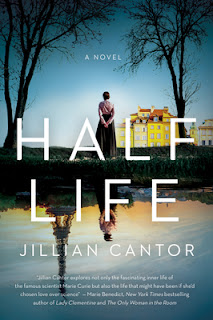
Half Life by Jillian Cantor

Image
  Maria (pronounced Marya) Sklodowska before she became Marie Curie and before she left Poland for France, she was in love with Kazimierz Zorawski. And this story explores what-if… she stayed in Poland with her first love by inventing a fictional character of Marya Zorawski. In parallel stories, we also get to know the real story of Marie as a scientist working with her husband Pierre Curie. Poland, 1891. Maria from early age knew that being mother wasn’t meant for her. Her “mind ached to learn.” And in Russian Poland women were not allowed to study. She is heart-broken when things don’t work out with the love of her life. But her father reminds her about her brilliant mind and that she needs to use it. The word – Sorbonne – is “like a confection for my mind, and my body hummed, alive again…” Then the story splits into imagined and real… At Sorbonne Marie excels. She is first in her class in physics examination. She is awarded the prestigious Alexandrovitch Scholarship. But she nee...